

Data-driven analysis: why AI projects stall before production — and why DataNature is the operational bridge enterprises have been missing.
Quick SummaryEnterprise AI production readiness has become the defining challenge for organizations in 2025. Despite billions invested in AI initiatives, only 4% of enterprises have successfully moved AI models into stable production. The other 96% are stuck somewhere between a promising demo and a working system — and the gap is costing them millions.
There’s a dirty secret inside most enterprise AI programs. The boardroom presentations are polished. The proof-of-concepts run beautifully on curated datasets. The data scientists are talented. And yet — somewhere between “this is incredible” and “let’s go live” — everything stops moving.
A 2024 study by McKinsey found that only 4% of enterprises have successfully scaled AI beyond pilot programs. Gartner corroborates this, citing that roughly 85% of AI projects fail to reach production in their intended form. Harvard Business Review’s research echoes the same finding: most organizations are generating AI activity without AI outcomes.
This isn’t a talent problem. It’s not a technology problem. It’s a systemic infrastructure and process problem — and it has a name: the AI Production Gap.
- 96% – Enterprises stuck in AI pilot purgatory
- $4.4T – Estimated annual AI value left unrealized
- 18mon – Avg. time from pilot to attempted production
- 87% – Data science models never make it to production
“We don’t have an AI innovation problem. We have an AI operationalization problem.”
— Gartner, Data & Analytics Summit, 2024
The AI Production Gap: What’s Actually Happening
To understand why enterprises fail, you need to understand the journey an AI project takes. It’s not a straight line from idea to production. It’s an obstacle course — and most teams fall at the same three hurdles.
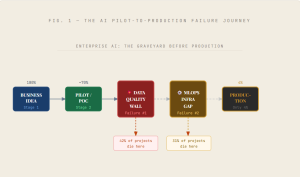
The Three Failure Points — By the Numbers
- Poor Data Quality & Governance (42%) : Models trained on siloed, inconsistent, or poorly labelled data produce unreliable outputs the moment they leave the sandbox. Real-world data is messier, more diverse, and subject to drift.
- No MLOps Infrastructure (31%) : There’s no pipeline for retraining, versioning, monitoring, or rollback. The model that worked last Tuesday is silently degrading today — and no one knows.
- Team Misalignment (Data Science vs. Engineering) (18%)Data scientists optimize for accuracy; engineers optimize for stability and speed. These two worlds speak different languages, use different tools, and have different definitions of “done.”
- No Clear Business Value Metrics (9%): Projects lack the KPIs to justify continued investment. When the CFO asks “what’s the ROI?”, the team can’t answer — and budgets get cut.
Why Traditional Approaches Keep Failing
The knee-jerk response from most enterprise IT departments is to throw more compute at the problem, hire more data scientists, or buy another SaaS tool. None of these address the root cause.
The root cause is this: enterprises treat AI as a project when they should treat it as a product.
A project has a start and an end. It gets built, shipped, and handed over to “someone else” to maintain. A product, by contrast, has a lifecycle. It evolves. It’s monitored. It adapts to feedback. It has owners, metrics, and a continuous improvement loop.
When AI is treated as a project, the data pipeline gets built once and never revisited. The model gets trained on historical data and never retrained. The outputs get consumed without quality gates. And gradually, silently — the model starts lying to the business, and nobody notices until the damage is done.
“Your AI model is not failing. Your data infrastructure around the model is failing. That’s the distinction that changes everything.”
— DataNature Technical Brief, 2025
The DataNature Insight: Data as a Living System
DataNature was built on a specific thesis: data in production is a living ecosystem, not a static resource. It shifts, grows, degrades, and mutates. An AI system that doesn’t account for this reality won’t just underperform — it will actively mislead.
The DataNature platform introduces what it calls Data Vitality Management — a continuous process of profiling, governing, enriching, and monitoring data as it flows through an organization’s AI systems. Think of it less like a database tool and more like an immune system for your AI stack.
The 4-Step DataNature Fix: From Pilot to Production in 120 Days
Here’s the operational framework that separates the 4% who ship from the 96% who stall. These aren’t abstract principles — they’re concrete implementation phases, each with measurable outputs.
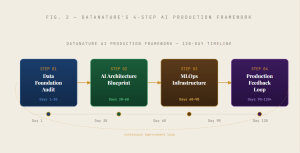
Before a single model is touched, DataNature conducts a systematic audit of every data source that will feed the AI system. This means cataloguing data lineage, assessing schema consistency, profiling data quality metrics (completeness, accuracy, freshness, uniqueness), and identifying governance gaps. The output is a “Data Vitality Score” — an honest baseline of where the organization stands. Most teams are shocked to find they’re operating at 40–60% data vitality when they thought they were at 90%.
✓ Deliverable: Data Vitality Score + Remediation Roadmap
The most common architectural mistake: building an AI system that works in development and then trying to retrofit it for production. DataNature’s blueprint phase flips this. Architecture decisions — serving infrastructure, latency requirements, fallback logic, compliance constraints, and scalability targets — are defined before model training begins. This ensures the model is built for the environment it will live in, not retrofitted into it. The result is systems that require 60% less rework to deploy.
✓ Deliverable: Production-ready architecture spec + infrastructure provisioning
A model without MLOps is like a race car without a pit crew. DataNature deploys a full model lifecycle management system: automated retraining pipelines triggered by data drift detection, model versioning with instant rollback capability, A/B testing frameworks for safe model promotion, and real-time performance dashboards visible to both technical and business stakeholders. Critically, DataNature connects the model’s operational metrics directly to business KPIs — so the “is this working?” question has a clear, quantified answer at all times.
✓ Deliverable: Live MLOps dashboard + automated retraining pipeline
Production is not the finish line — it’s the starting line. DataNature’s fourth phase establishes a feedback architecture that captures real-world model interactions, routes edge cases back to human reviewers, integrates business outcome data into model evaluation, and feeds all of this into a structured retraining cadence. This is what transforms a one-time AI deployment into a continuously improving business asset. Organizations that implement this phase report 3–5× better model performance over a 12-month horizon compared to static deployments.
✓ Deliverable: Production system live + continuous improvement flywheel active
How to Know If Your Enterprise Is in the 96%
Honest self-assessment is the first step. Here are the six signals that tell you an AI project is heading toward the production graveyard:
- Your data science team and engineering team rarely talk. If model handoffs feel like throwing work over a wall, you have a structural problem that no amount of better tooling will fix.
- You’ve never done a formal data quality audit. If you don’t have a number for your data’s reliability, you don’t actually know what your model is learning from.
- Retraining a model requires a heroic manual effort. If retraining takes days and requires multiple team members, your model is already degrading faster than you can fix it.
- There’s no alert system for model drift. Without drift detection, you will only find out your model has degraded when a business outcome goes wrong — not before.
- You measure model success with technical metrics only. Accuracy, F1, precision — these are necessary but not sufficient. If you can’t connect model performance to revenue, cost, or risk metrics, your stakeholders will defund the project.
- Your AI projects keep cycling back to “let’s retrain from scratch.” This is the clearest signal of all. It means the feedback loop is broken and the operational infrastructure was never built.
If you recognize three or more of these signals, your organization is firmly in the 96% — and the gap between where you are and where you need to be is not a talent gap. It’s a systems gap.
The Strategic Consequence: Why This Matters More Than Ever in 2025
In 2023, the AI race was about who could build the best prototype. In 2025, it’s about who can operate AI at scale — reliably, responsibly, and continuously. The competitive advantage has shifted from innovation to operationalization.
Organizations that figure out production AI first will compound their advantage rapidly. Every month of live production data makes their models smarter. Every feedback loop makes their systems more aligned to business reality. Meanwhile, the 96% keep cycling through failed pilots, burning budget, and eroding stakeholder confidence in AI as a whole.
The window for competitive advantage is not closing slowly. It’s closing fast. The enterprises that move from pilot to production in the next 12 months will have a structural data and model advantage that will be nearly impossible to overcome two years from now.
“In 2025, the question isn’t whether to use AI in your enterprise. It’s whether you can operate it. The 4% who can are pulling away from the field.”
— DataNature, Enterprise AI State of Play, 2025
👉 Explore how Datanature can help enterprise grow as data-driven business
👉 Explore how AI360 Studio can help your organizations
👉 Contact our team for a demo: https://dlytica.com/contact-us