Top Artificial Intelligence Trends Every Student Should Know in 2026
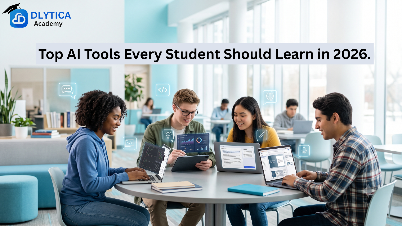
Top AI Trends to Know Before You Start Your Tech Career
From studying and coding to research and creative work, these AI tools can boost your output and prepare you for tomorrow’s careers.
Artificial intelligence is no longer a far-off dream — it’s already part of how you study, research, write, and build. From healthcare and finance to entertainment and gaming, companies everywhere are hiring people who understand these tools. So here’s your fast, friendly tour of the AI trends worth knowing before you launch your tech career — plus the tools and skills to get ahead.
1. Generative AI
Generative AI lets machines create original content such as text, images, videos, music, slides, and code from simple prompts. Because it runs on powerful large language and multimodal models, it is changing how teams handle content creation, research, software building, marketing, education, and product design.
Why it matters: The ability to prompt, judge, and refine AI-generated content is fast becoming a core workplace skill. As a result, people who master it work faster, think more creatively, and solve problems with less effort.
2. Agentic AI
Agentic AI is the next step in artificial intelligence. Unlike older AI that simply answers questions, AI agents can reason, plan, make decisions, use outside tools, pull in data, and finish multi-step tasks with little human help. In other words, these systems can automate whole workflows rather than single tasks.
Why it matters: More and more businesses now deploy AI agents to lift output. Therefore, people who can design, monitor, and work alongside these systems will be in high demand.
3. Machine Learning & Deep Learning
Machine learning helps computers spot patterns in data instead of following hand-written rules. Deep learning, a special branch of machine learning, uses neural networks to solve harder problems such as image recognition, speech processing, recommendations, fraud detection, and forecasting.
Why it matters: These two fields form the base of modern AI. For that reason, a solid grasp of machine learning opens doors to careers in AI, data science, robotics, healthcare, finance, and many other fast-growing fields.
4. Natural Language Processing (NLP)
Natural Language Processing (NLP) helps computers understand, interpret, generate, and reply to human language. For example, it powers chatbots, virtual assistants, voice recognition, translation, document summaries, search engines, and sentiment analysis.
Why it matters: Since businesses lean more and more on conversational AI and language-based automation, NLP has become one of the most practical and in-demand fields in artificial intelligence.
5. Computer Vision
Computer vision gives machines the power to read and understand images and video. In practice, it drives facial recognition, self-driving cars, medical scans, quality checks in factories, smart cameras, augmented reality, and farm monitoring.
Why it matters: Visual data is growing fast across every industry. Consequently, computer vision experts play a key role in building smarter, more efficient AI tools.
6. AI in Cybersecurity
Artificial intelligence is reshaping cybersecurity. It spots threats faster, flags odd behavior, blocks fraud, reads network traffic, and responds to attacks on its own. Moreover, these systems keep learning from new threats, so security becomes more adaptive over time.
Why it matters: Cybercrime keeps evolving. Because of this, companies need people who can blend security know-how with AI skills to protect key digital systems.
7. AI-Powered Automation
This trend pairs artificial intelligence with robotic process automation (RPA) to handle repeat tasks, rule-based work, and even some decisions. As a result, companies cut costs, reduce errors, and improve customer service.
Why it matters: Automation is reshaping the future of work. So professionals who know how to plug AI into business processes will be better placed to lead digital change.
8. Edge AI
Edge AI brings intelligence straight to devices such as phones, cameras, drones, wearables, robots, and IoT sensors. Instead of sending data to the cloud, the device does the thinking locally. This means faster responses, lower delay, better privacy, and less need for a constant internet link.
Why it matters: Smart devices are everywhere now. For this reason, Edge AI is becoming vital for healthcare, factories, transport, smart homes, and industrial automation.
9. Explainable & Ethical AI
This field focuses on building AI that is open, fair, accountable, secure, and free from harmful bias. In short, it makes sure AI decisions can be understood, trusted, and checked — while also protecting privacy and meeting legal standards.
Why it matters: Governments and companies now put responsible AI first. Therefore, people who understand AI ethics and governance will play a key part in building AI we can trust.
10. AI for Data & Business Intelligence
Here, machine learning, predictive analytics, and data visuals come together to turn raw data into clear insights. Businesses then use these insights to forecast trends, fine-tune operations, personalize customer experiences, spot risks, and guide big decisions.
Why it matters: Companies rely on data to stay ahead. Because of that, people who can mix AI, analytics, and business strategy rank among the most valued talents in today’s digital economy.
Your 2026 AI Toolkit
Nine tools that quietly save students hours every week. Rotate between two or three free ones, and you’ll cover most of your academic life.
Skills That Set You Apart
As AI takes over routine work, human skills become more valuable — not less. So these are the ones worth sharpening now.
Learning With AI, Responsibly — Use AI the Smart Way
- Try it yourself first. Reach for AI to compare and refine — not to skip the thinking that builds real skill.
- Always verify. After all, AI can sound confident and still be wrong (“hallucinate”). Cross-check facts and figures.
- Make it yours. Read, process, and rewrite in your own words so the understanding actually sticks.
- Stay within the rules. Above all, know your school’s policy and be open about how you used AI.
Where Dlytica Academy Comes In
Reading about AI trends is a great start — but real careers are built on hands-on practice. That’s exactly what Dlytica Academy is designed for.
Dlytica Academy delivers Data & AI training paired with real internship experience across Canada, the USA, Nepal, and worldwide. Instead of just theory, you learn by building — with live online sessions, industry mentors, and real-world projects that turn concepts into job-ready skills.
Why students choose Dlytica
- ✓ Hands-on courses in Data Science Agentic, Generative AI/ML, Data Analytics with AI, Data Engineering with AI, Cybersecurity with AI, DevOps with AI, and QA with AI
- ✓ A practical stack you’ll actually use: Python, TensorFlow, Scikit-learn, SQL, and Power BI
- ✓ Live, mentor-led sessions with ongoing feedback — plus flexible, self-paced options
- ✓ Built-in internships and real projects that give you genuine work experience
- ✓ Industry-recognized certification, along with in-house job openings for trained candidates
Ready to turn curiosity into a career? Enroll now: https://www.dlytica.com/course/it-career-guide
