Why Businesses Are Investing Billions in Cybersecurity
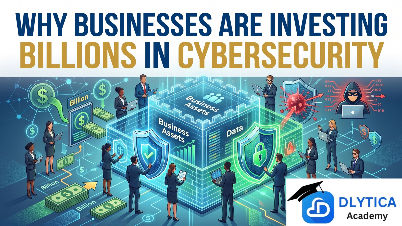
Why Cybersecurity Is the Hottest Hiring Market Heading into 2026
Cyberattacks now cost businesses more than $8 trillion a year worldwide. Worse still, the figure keeps climbing. So this week, we look at why cybersecurity has become one of the fastest-growing corners of tech heading into 2026. We’ll also cover the roles and skills employers are scrambling to hire for right now.



The Price Tag of Doing Nothing
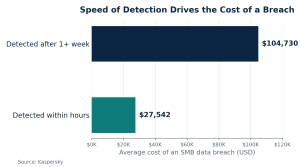
The case for cybersecurity spending starts with simple math. A single breach now carries a steep cost. In Canada, the average data breach costs companies $5.64 million, according to Mastercard figures cited by Compugen. Meanwhile, Kaspersky’s research looks at smaller firms. There, a breach costs roughly $27,500 on average when caught quickly. However, that balloons to over $104,000 once detection takes longer than a week.
Yet proper protection is still the exception, not the rule. Mastercard’s data, again via Compugen, found that only 39% of businesses have put strong security measures in place. As a result, most remain exposed. This comes at a time when global spending on security and risk management was already set to hit $215 billion in 2024, per Gartner. In short, companies spend less than they need — and that gap is exactly why cybersecurity hiring is so hot.
Why the Spending Keeps Climbing
Four forces are pushing budgets upward, according to analysis from Michael Page and Abusix:
Expanding attack surface. Remote work, mobile devices, and cloud adoption have multiplied the entry points for attackers. Moreover, mobile devices are small and portable, which makes them easy to lose or compromise.
Customer trust as a sales asset. A visible security program has become a real differentiator. Businesses that can prove their data is protected earn loyalty from customers, investors, and partners. Consequently, competitors without strong security struggle to match that trust.
The cost of going without is higher. Skipping the investment doesn’t remove the cost — it just moves it. Later on, companies without security teams often pay far more. Think higher insurance premiums, recovery costs, and lost business after an incident.
Regulatory exposure. Major business hubs have introduced data protection rules. Because of this, a breach can trigger audits, penalties, and reputational damage with lenders and insurers. All of that lands on top of the direct financial loss.
More Spending, Same Breaches?
Here’s the uncomfortable twist: bigger budgets haven’t made companies safer. Compugen’s analysis points to a paradox. Heavy spending and constant breaches now exist side by side. The cause is what it calls a “porous enterprise.” Hybrid work, sprawling cloud setups, and connected supply chains all expand the attack surface. In fact, they grow it faster than security teams can lock it down. Worse, a single weak link in a vendor network can expose an otherwise well-defended company.
Compugen also flags a diminishing-returns problem. Many organizations stack disconnected security tools without a unifying strategy. This creates vendor fatigue, scattered logs, and blind spots. Paradoxically, risk goes up even as spending rises. Kaspersky’s research adds a related insight. Many businesses over-invest in prevention, such as firewalls and antivirus. At the same time, they under-invest in response and recovery planning. So when an attacker does get through, they’re slow to act.
The fix both sources point to isn’t more tools. Instead, it’s a coordinated, business-aligned security strategy. And that shift is exactly what’s reshaping the cybersecurity job market.
The Skills Employers Are Racing to Hire For
Companies are moving from piecemeal tools toward holistic, response-ready security programs. Therefore, hiring demand is now clustering around a specific set of skills:
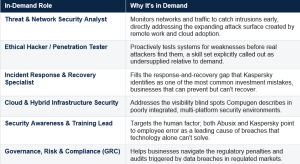
Notably, none of these roles are purely technical anymore. Employers want people who can connect security decisions to business outcomes. That’s exactly the gap that tool-by-tool hiring has left open.
Build Your Cybersecurity Career with Dlytica Academy
Dlytica Academy’s Cyber Security Course with AI is built around the exact skills this market wants. The program covers network security, ethical hacking, and threat analysis. Everything is taught through live, instructor-led sessions and hands-on projects. It’s open to learners in Canada, the USA, and Nepal. In addition, the program pairs core training with an internship track. That track provides real Canadian work experience, industry certification, and job placement support.
| Cyber Security Course with AI
Network security • Ethical hacking • Threat analysis • Internship pathway • Industry certification ► Apply Now: https://www.dlytica.com/course/it-career-guide #ITTrainingNepal #ITTrainingCanada #InternshipProgram #CareerInTech #UpskillNow #LearnWithDlytica #DlyticaAcademy #CyberSecurityTrainingNepal |